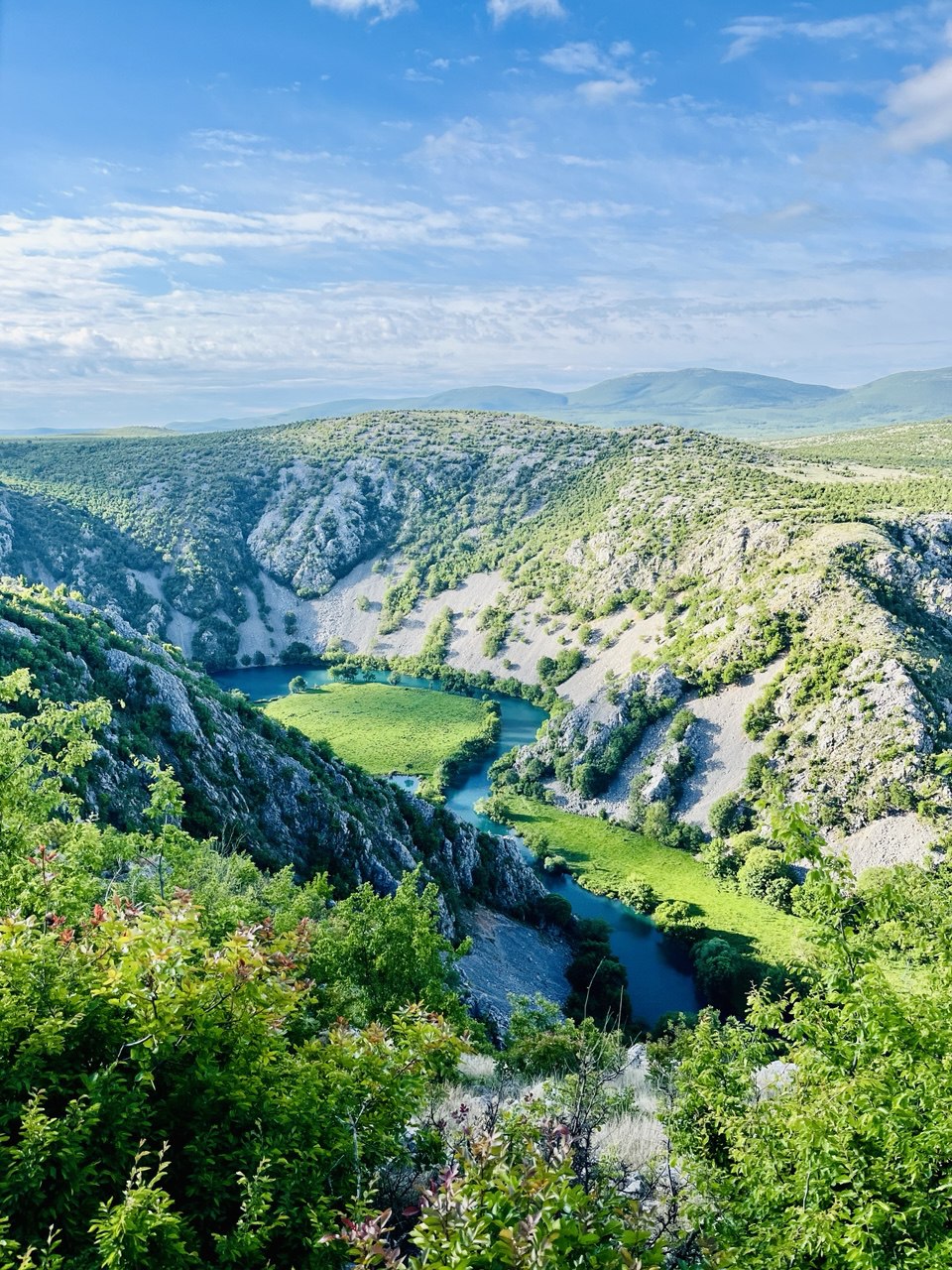
This article continues my adventure in the foothills of Rumija, near the town of Bar in Montenegro. I’ve described my hike from the mountain village of Tudjemili along the Željeznica River, through the hamlet of Dumezić to the Skak Waterfall, and then on to the Zup Waterfalls. And here I got a little “stuck,” since according to my original plan, I was supposed to cross the Željeznica River at this point, hike over the mountain to the Ribnjak Monastery, and climb Gradac Hill, where I wanted to visit the Church of St. Basil of Ostrož. When I found a spot near the Zup Waterfalls marked with a sign as a ford, I just smiled to myself and realized that with the water level as it was, “this way is impassable ☺” and that I would have to take a detour to reach the Ribnjak Monastery.


First, I walked past the Zup waterfalls and the Željeznica River back to the hamlet of Dumezić. There I found the right path, which led me to a bridge over the Željeznica River. I walked half a kilometer along the river and found myself in the village of Zupci. Considering that it has only about 115 permanent residents, it is quite large. It is located on the southwestern slopes of the Vrsuta Mountains, below the Sto peak.


After walking about a kilometer through the village, I came to the Catholic Church of St. John the Baptist. It’s a beautiful building in a lovely setting, but I really didn’t expect to see plastic windows on the church. Above the entrance door, I read an inscription stating that “the local residents rebuilt this church from the ground up in 2006.” That piqued my interest, so I decided right then and there to do a little digging ☺.


I discovered that a different Catholic church, the Church of St. John the Baptist, originally stood on this site. I was unable to find out what happened to it or why it had to be rebuilt in 2006. However, I did learn that the original church was built in 1844 from the remains of an even older church (also dedicated to St. John the Baptist), which had been moved to the newer part of the village of Zupci from the site of Ribnjak (it was destroyed by an earthquake in 1667). I was a bit confused, since I thought there was an Orthodox monastery in Ribnjak, and since I was headed that way anyway, I decided to look into it properly.

I discovered that today’s Orthodox monastery of Ribnjak is built on the foundations of the Monastery of St. John the Baptist, which was commissioned by Helena of Anjou (c. 1230–1314), later known as Saint Helena of Serbia, the Serbian queen and wife of King Stefan Uroš I. Nemanjić, and mother of the future kings Dragutin and Milutin. Her origins are unclear, but several historians refer to her as “French.” She married around 1245. She supported the Roman Catholic faith and commissioned the construction of several Catholic churches in Kotor, Bar, and Ulcinj. I was very intrigued by the fact that she was canonized by the Serbian Orthodox Church (as a representative of the Catholic faith). In Serbian folklore, she is associated with the lilac—it is said that she was the one who “brought” lilacs to Serbia. Today, Serbia celebrates Dani jorgovani (Lilac Days) annually in her honor.
Historians estimate that the Monastery of St. John the Baptist in Ribnjak was built between 1250 and 1280. The church’s foundations from that period have been preserved in Ribnjak to this day. During construction, Helena had two oak trees planted in honor of her sons. One of them did not survive to the present day, but the other can still be admired today.
So that’s the long history behind the small, unassuming church in the village of Zupci ☺.


From the Church of St. John the Baptist, I headed toward Ribnjak. I chose the longer but “mud-free ☺” route, which took me about an hour (2.8 km).


The Orthodox monastery was built in the late 19th and early 20th centuries and is dedicated to St. Basil of Ostrog. It consists of several churches, living quarters, and farm buildings. I didn’t enter the grounds, as it was already late and I needed to return to my car in the village of Tudjemili.

A rocky hill rises above the area toward the Rumija Mountains, with the ruins of the Crni Krš fortress at its summit.

If we look toward the Vrsuta Mountains, we can see Gradac Hill above the monastery grounds (which I had originally planned to climb). At its summit stands the Church of St. Basil of Ostrož, which is associated with an interesting legend. When the Montenegrin army, led by Prince Nikola Njegoš, fought the Turks for the city of Bar in November 1877, its main force, along with the prince, camped on the Ribnjacka Plain to rest. The prince climbed Gradac Hill and fell asleep there. In his dream, Saint Vasilije Ostroški appeared to him and told him that he would conquer Bar by Christmas. And so it happened; on January 9, 1878, the Turks raised a white flag over Bar. Prince Nikolai had a church built on the spot where the saint had appeared to him (the church was consecrated on May 12, 1879—today celebrated as Vasilije’s Day).
I take one last look at the monastery and hurry to Tudjemili. After 2 kilometers, I’m already on the paved road (R-28), and I practically run the remaining half kilometer ☺. I jump in the car and rush back to my lodging to photograph the sunset.


If you decide to follow in my footsteps and need advice on accommodations, food, hiking trails, or other ways to spend your time on the coast near Bar or Sutomore, feel free to contact me via email at ajka@uzisibalkaninak.com, my Facebook page “Enjoy the Balkans differently” or Instagram.

P.S.: All photos are mine and are protected by copyright 🙂 …