
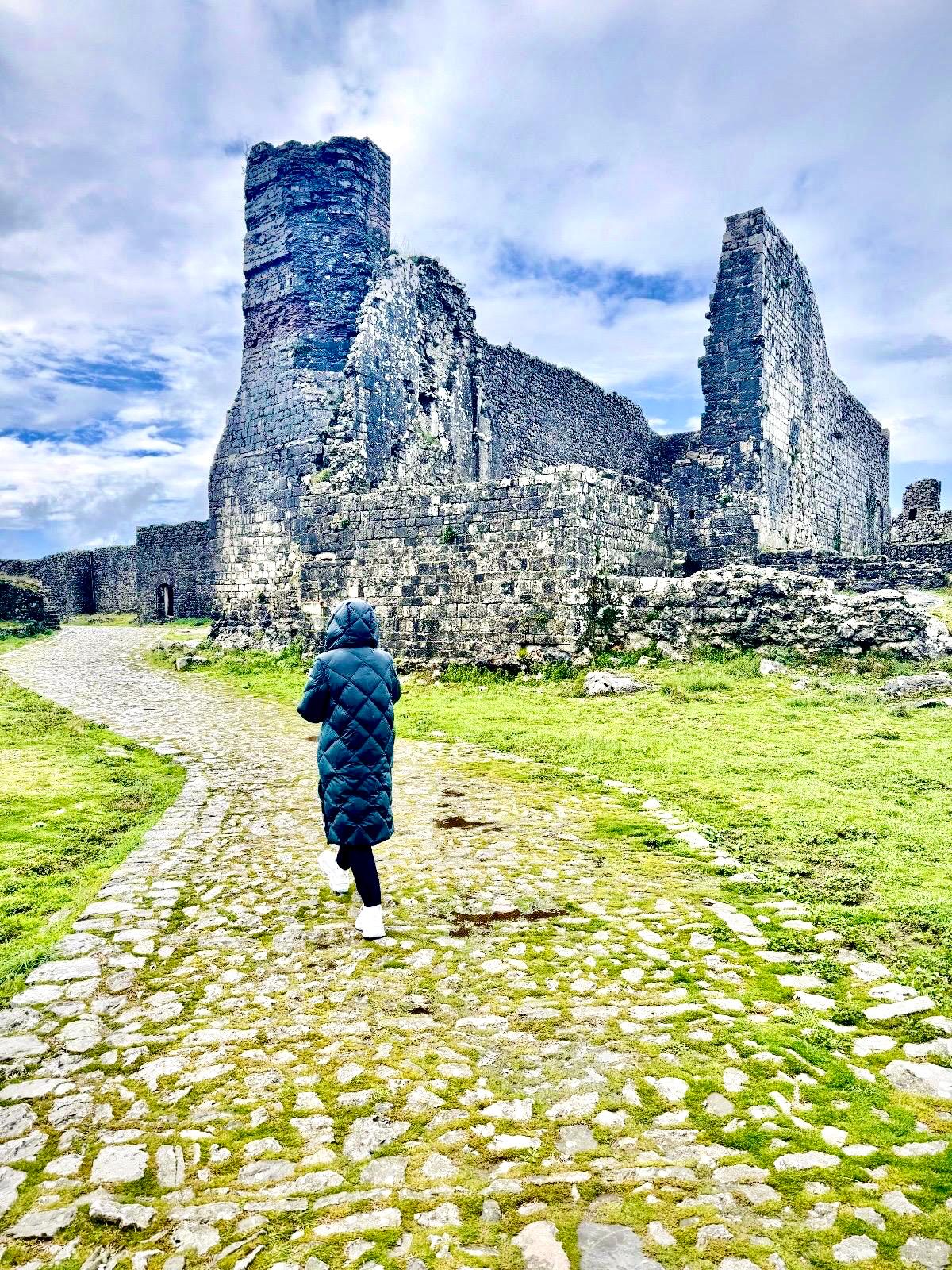
As the title says, today I’m taking you to northern Albania, to the city of Shkodër (also known as Skadar in Slovak). And since it’s truly a vast and significant historical monument, I’ll be focusing exclusively on Rozafa Castle ☺. The castle is the main tourist attraction in Shkodër. I’ll give you a detailed historical overview, interspersed with my photos and videos as well as my impressions ☺.


The city of Shkodër is located in northwestern Albania, on the shores of the lake of the same name (Lake Skadar), and stretches to the point where the two rivers—the Buna and the Kir—converge. This city has not changed its name for over 2,000 years. The Romans called it Scodra—as did the Greeks. Today, it is the largest economic and cultural center of northern Albania. The Drin, Buna, and Kir rivers flow through it, and it is surrounded by the Maranaj Mountains to the north, the Cukali and Sheldia Mountains to the east, and the Taraboshi Mountains to the southwest.
*Ancient Times*
Rozafa Fortress stands on a rocky hill west of the city of Shkodër and is surrounded by the Bune, Drin, and Kir rivers. Its walls cover an area of approximately 9 hectares. Traces dating back to the Early Bronze Age have been discovered on the southern side of the hill. Construction of the fortress began in the 5th–4th centuries B.C. ; massive stones were used, stacked on top of one another without mortar, and traces of them remain to this day. In antiquity, this site was inhabited by the Illyrian tribe of the Labeates. During this period, the city experienced significant development, as evidenced by a coin in circulation since 230 BC. Thanks to this archaeological find, we know that the city was called Scodrinon at that time. In 181 BC, the city became the capital of the Illyrian Kingdom under King Gentius. During this period, the city was located on the southern slope of the hill, surrounded by walls and entrance gates, while the Illyrian Acropolis was built on the hill where Rozafa Castle stands today. The most visible traces of the Illyrian period at the castle can be found in the small courtyard between the Barbican and the second gate.


During the 2nd century B.C., wars with the Roman emperor took place in the vicinity of the castle, and in 168 BCE, it was conquered by the imperial army. During the reign of Diocletian, the town (thanks to his reforms) became the administrative center of the province of Preval.
*The Middle Ages*
During the Byzantine conquests, the city was captured and in the 11th century became the capital of the state of Zeta (1040). Later, it was briefly occupied by the Bulgarians. In the 14th century, the city became an important autonomous center and, in 1360, also the capital of the Balšajovci principality. In 1396, it came under Venetian rule—at that time, it was called Skutari. It was during this period that the castle took on the form it has today. The entire complex was completed in 1468, when the Venetians, after suppressing a series of uprisings by the local population, were preparing for the Ottoman invasion.


*Ottoman occupation*
In 1478, Sultan Mehmed II laid siege to Shkodër with an army of more than 100,000 men (it was the last unconquered castle for miles around). The defense of Shkodër lasted approximately 8 months, with the castle defended by a garrison of only 1,600 men. On April 25, 1479, following an agreement between Venice and the Ottomans, the castle was handed over to the Ottomans.


During the occupation, the town and castle were restored, and in the 17th century they even became the center of the Sanjak. From the late 17th century, the city began to expand into the areas we know today. Below Rozafa Castle lies the Lead Mosque (discussed in another article), which was built in 1768 by Mehmet Pasha the Elder Bušatlidž and served as the city center until the end of the 18th century. During the reign of the Bušatlidž family, Shkodër experienced significant development. A bazaar with more than 2,500 shops was built, making it the largest in the Balkans. At that time, the city had 50,000 inhabitants. Until 1858, the castle served as the seat of the city governor. In 1865, the city administration moved to the new center of Shkodër, and the castle served only as a base for the Ottoman military garrison.

*The Present*
In 1948, Rozafa Castle was designated a cultural monument and is protected by the state. Its first restoration began in 1971. At that time, St. Stephen’s Church was restored; its construction dates back to the late 13th century, and after the Ottoman occupation, it was converted into a mosque (1479). In May–June 2012, 16th-century tombs were discovered at the castle.


*Fortress*
The interior of the castle complex is divided into three courtyards, separated from one another by gates. In each courtyard, there are buildings in varying states of preservation, such as a round tower, a warehouse, and a three-story building from the Venetian period. There are also four water reservoirs here. There is a prison here as well, and, as I mentioned above, a church converted into a mosque.


The castle occupied an important strategic position, which allowed it to control a vast territory. It served as the center of a comprehensive defensive system consisting of a series of other smaller castles, such as Balleza, Drishi, Danja, and others.


The Rozafa Castle Museum is located in the third (highest) courtyard. It is housed in a 15th-century building known as the “Captain’s Quarter,” which served as the residence of the castle commander. In front of its entrance stands a work by the Shkodër artist Skender Kraju. The work depicts the legend of the castle’s founding, which we’ll discuss in more detail. There is also a restaurant operating in these historic spaces where you can grab a bite to eat.


*The Legend of the Fortress’s Origins*
Albanians have passed this story down from generation to generation. According to legend, three brothers tried to build a fortress, but every night the walls they had just built collapsed. The brothers were at their wits’ end, so they sought the advice of a wise old man, who told them that a human sacrifice was needed to break the curse.


It was decided that the first wife to bring lunch to the workers would be walled up. It was Rozafa, the young wife of the youngest brother, who unwittingly sealed her fate. She accepted her fate, but on one condition: her right eye, right hand, right breast, and right leg would remain uncovered so that she could continue to raise and care for her child. This story is not only a testament to Rozafa’s self-sacrifice but also an enduring symbol of maternal devotion and sacrifice. It reflects deep cultural values that still resonate in Albanian society today. It is a poignant story that highlights the themes of sacrifice and fate that permeate Albanian folklore.
*My impressions of Rozafa Fortress*
Since my husband and I were completely alone there, I was able to fully immerse myself in the atmosphere of this amazing structure. The fortress reflects various historical periods, and its architecture features elements of Illyrian, Roman, Byzantine, Venetian, and Ottoman influences. Every stone tells a story of the military strategies, cultural influences, and architectural innovations of that era.


The castle is entered through three main gates, each representing a different architectural style. The first gate is Roman. The second and third gates reflect Byzantine and Venetian influences and illustrate the evolution of military architecture over the centuries. To me, these gates are more than just entry points. They are historical “milestones,” each with its own story of conquest, defense, and adaptation to the times and technologies.


The walls of Rozafa bear witness to the fortress’s primary defensive role. They are built to withstand sieges and attacks. Every layer of stone and mortar is a silent witness to the countless battles fought for control of this strategic location.


I was particularly fascinated by the ruins of the church and the mosque. The church, originally built during the Byzantine era, was later converted into a mosque during the Ottoman period. For me, this is a manifestation of the cultural and religious diversity for which the city of Shkodër has always been known, and remains so to this day. Again, it is not just about architectural elements. These are symbols of the cultural and religious dialogues that have taken place in this region.


It was both an educational and inspiring experience that allowed me to connect tangibly with history. The castle walls and breathtaking views provide the perfect backdrop for exploring the castle’s various sections. And it’s not just about discovering history. It’s an opportunity to connect with the timeless stories that have shaped Albanian identity.


Na záver vám ponúkam ľudovú legendu, preloženú z albánskeho jazyka. Ide o hrubý preklad, tak za niektoré nepresnosti sa vopred ospravedlňujem ☺ :
A fog descended upon the Buna and shrouded everything. This fog remained there for three days and three nights. After three days and three nights, a gentle breeze blew and dispersed the fog. It blew it toward Valdanuz Hill. Three brothers were working at the top of the hill. They were building a castle. But the wall they built during the day collapsed at night, so they couldn’t finish it.
A kind old man passes by.
“Good day, three brothers!”
“Thank you, kind old man. But where do you see the good in us? We work by day, and by night it all comes crashing down. Do you have any advice on what we can do to keep the walls standing?”
“I know,” says the old man. “But I’m afraid to tell you, because it’s a sin.”
“Lay that sin upon us, because we want to finish building this castle.”
The good old man asks,
“Are the three of you married?”
“We’re married,” they say. “All three of us have wives. So tell us, what must we do to finish building this castle?”
“If you want the walls to stand, you must not tell your wives what I’m about to say. The one of the three wives who brings you food first tomorrow must be walled up alive in the castle wall. Then the wall will stand firm and last forever.”
The old man said this and left.
The eldest brother broke his word. He went home and told his wife not to go there the next day. The middle brother also broke his word—he told his wife. Only the youngest kept his word—he didn’t tell his wife anything about the old man’s claim.
Morning. The three brothers get up quickly and go to work. Hammers strike, stones break, hearts beat, walls rise.
At home, the boys’ mother knows nothing. She says to the eldest son’s wife:
“My eldest daughter-in-law, the men want bread and water; they want pumpkin with wine.”
The daughter-in-law makes an excuse: “Besa, Mom, I can’t go because I’m sick.”
She turns to the daughter-in-law of the middle son and says: “My middle daughter-in-law, the boys need bread and water; they want pumpkin with wine.”
– Besa, Mom, I can’t go because I have to visit relatives.
The boys’ mother turns to her youngest son’s wife:
– My youngest daughter-in-law…
The daughter-in-law stands up:
– Yes, Mom!
– The boys want bread and water; they want pumpkin with wine.
– Besa, Mom, I can’t go, I have a little boy. I’m afraid he’ll want milk and start crying.
– Go, go, we can watch the boy, we won’t leave him alone – say the sisters-in-law.
She gets up, takes the bread and water, takes the pumpkin with wine, kisses the boy on both cheeks, leaves, and goes to Kazen; there she climbs Valdanuz Hill and comes to the place where three men are working: her two brothers-in-law and her husband.
“Good work, masters!”
The hammers stop, but their hearts beat faster and stronger. Their faces pale. When the youngest brother sees his wife, he throws down his hammer and curses the stone and the wall. His wife says:
– What’s wrong, my husband? Why are you cursing the stone and the wall?
The eldest brother-in-law says: – You were born on a dark day, my sister-in-law. We have decided to wall you up alive in the castle wall.”
“As you say, brother-in-law. But I have a condition: when you wall me up, leave my right eye out, my right hand out, my right foot out, my right breast out. For my son is small. When he starts to cry—I’ll look at him with one eye, stroke him with one hand, rock his cradle with one foot, and feed him milk from one breast. Let my breasts harden, let the castle stand, let my son be brave, let him be king and reign!
They take the bride and wall her up at the foot of the castle. And the walls rise, rise, no longer crumbling as before. The stones are still wet and covered in moss, because a mother’s tears for her son still fall…
And the son? The son grew up, fought, and reigned.

If you decide to follow in my footsteps and need advice on accommodations, food, hiking trails, or other ways to spend your time around the Albanian city of Shkodër, feel free to contact me via email at ajka@uzisibalkaninak.com, my Facebook page “Enjoy the Balkans differently” or Instagram.
P.S.: All photos are mine and are protected by copyright ☺ …


One thought on “Albania’s historical gem – Rozafa Fortress”